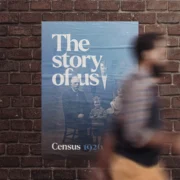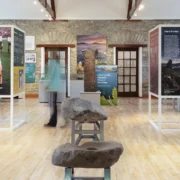
Over the past few months, New Graphic has worked with the National Archives of Ireland on the naming and design of the 1926 Census project, The Story of Us.
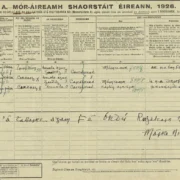
If you look closely at the census forms, you might notice nuances in the handwriting compared to the way we write Irish today. Many people filled in their return forms using Irish lettering, or Cló Gaelach (Irish type), which has an important place in Ireland’s typographic heritage.
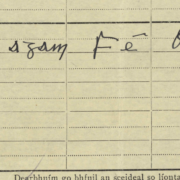
One striking example is the return for republican Máire Nic Shuibhne. She completed her form in Irish but refused to sign it in the standard way. Instead, she added an inscription that the census Garda translated in pencil: “This information is given by order of the Government of the Republic”. The entry captures both an ordinary household record and the political tensions that defined the new Free State.
Cló Gaelach has roots in the seventh-century Irish script found in manuscripts. While it shares the familiar fada, it also uses the ponc séimhithe, a dot placed above consonants to mark lenition (the softening of consonants in Irish grammar). This dot was later replaced by the letter “h” as Ireland moved to Roman letterforms. Cló Gaelaċ became Cló Gaelach.
A brief history of Irish type
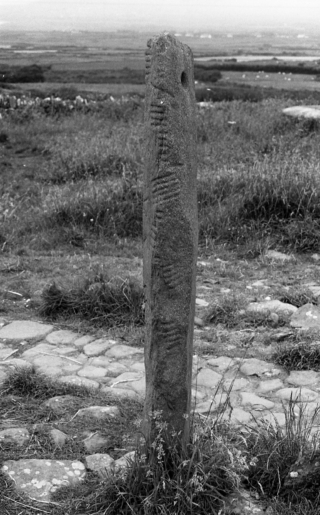
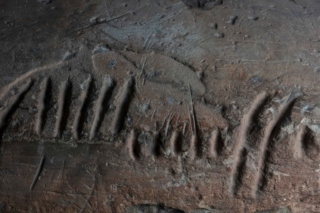
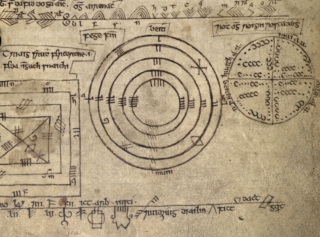
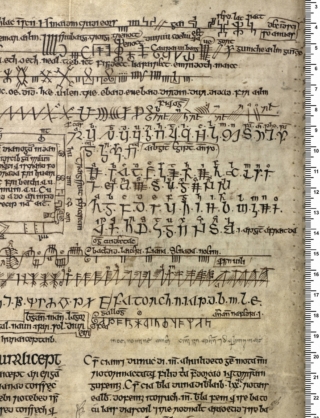
Cló Gaelach forms part of a much longer timeline of writing systems designed for the Irish language. Ireland’s earliest writing system, Ogham, is over 1,500 years old. Often compared to runes, Ogham consists of notches and lines carved into stone along a stem-line, with each character representing a sound in early Irish. In the Book of Ballymote, we can find both the later ‘manuscript Ogham’ and Irish lettering in the Ogham tract, which outlines its grammar and use in manuscripts. A unique element is the circular composition titled Fege Fín (Finn’s Window), in reference to the folklore sagas of Finn and Brian Boru which part of the manuscript is devoted to.
1800s-1900s
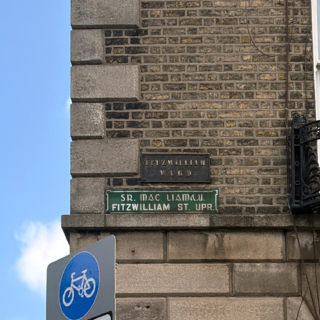
By the late nineteenth and early twentieth centuries, Cló Gaelach was more than a writing system. It became a visible symbol for Irish identity, and a way of differentiating Ireland from its nearest neighbour. Before independence, Irish-language street signs had little official standing, which made such signage inherently political. Irish lettering on signs, shopfronts and printed material became a quiet but powerful expression of national identity.
Discussing the introduction of bilingual street signs at the turn of the 19th century in his book Layers, Design and Cultural Historian Tom Spalding notes: “Street signage has a strange double identity of being commonplace, but also of carrying underlying messages about authority and control”. 1 We still see news of this dynamic in the North of Ireland.
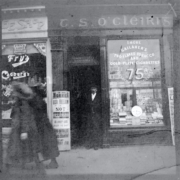
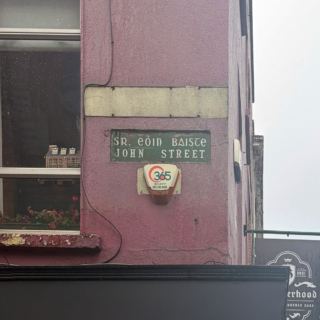
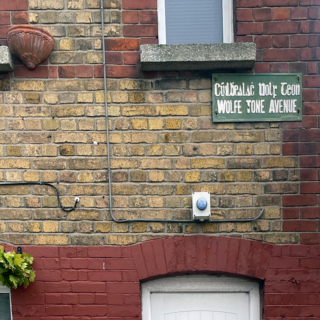
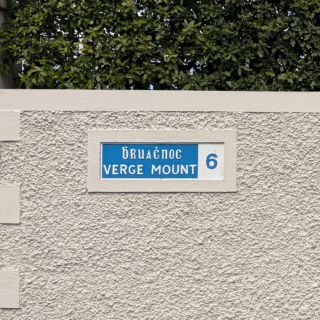
Many historic Cló Gaelach street signs are still in place across Ireland, with Dublin’s dark green street plates dating to before independence and the blue mid-century bilingual street signs among the last official street plates to use Irish lettering. A recent project mapping Cló Gaelach street signs is Dr Nicole Volmering’s Clóscape project, which has also helped renew interest in their cultural significance.
After Independence
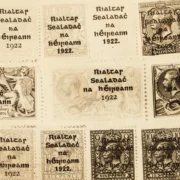
Irish lettering remained important after Ireland gained independence. According to the National Library of Ireland, one of the first visual marks of the 1922 Irish Provisional Government was the overprinting of British stamps with Irish lettering.3
By the 1926 Census, Cló Gaelach maintained strong associations with Irish identity and statehood. It remained the national writing system for Irish until the mid-twentieth century, when debates began over tradition versus modernisation and over which letterform should represent the Irish language. The eventual transition to Roman letterforms was driven by several factors, but primarily by concerns about modernisation, cost and legibility. 4
In retrospect, we might say that the loss of Irish lettering came at a considerable cultural cost, especially when we consider how it might have evolved alongside today’s design industry.
- Spalding, Tom (2013) Layers: The Design, History and Meaning of Public Street Signage in Cork and Other Irish Cities. Dublin: Associated Editions.
- Volmering, Nicole (n.d) Clóscape.
- Hogan, W. D. ‘British Postage Stamps with Irish Provisional Government Logo’. 1922. Available at: National Library of Ireland
- Bolger, Mary Ann (2016) Designing modern Ireland: the role of graphic design in the construction of modern Ireland at home and abroad (1949-1979) PhD thesis. School of Arts & Humanities. Royal Irish Academy. Available: Royal College of Art
Reading:
- Bolger, Mary Ann (2008) Design Factory: On the Edge of Europe. Lilliput Press.
- Dixon, Brian (2012) “Word and Place in Irish Typography,” InPrint: Vol. 1: Iss. 1, Article 3. Available at: Arrow TU Dublin
- Maynooth University (n.d) The ogham stones which show off the earliest writing in Ireland. Available at: Maynooth University
- McGuinne, Dermot (2010) Irish Type Design. 2nd edition. Dublin: National Print Museum.
- O’Neill, Timothy (1984) The Irish Hand. Portlaoise: The Dolmen Press Ltd.
- Volmering, Nicole. (2024) ‘Gaelicisation, Education and the Gaelic Script’. in Irish in Outlook: A Hundred Years of Irish Education, ed. Nicole Volmering, Claire Dunne, John Walsh, and Noel Ó Murchadha, p. 271–301. Lausanne: Peter Lang.